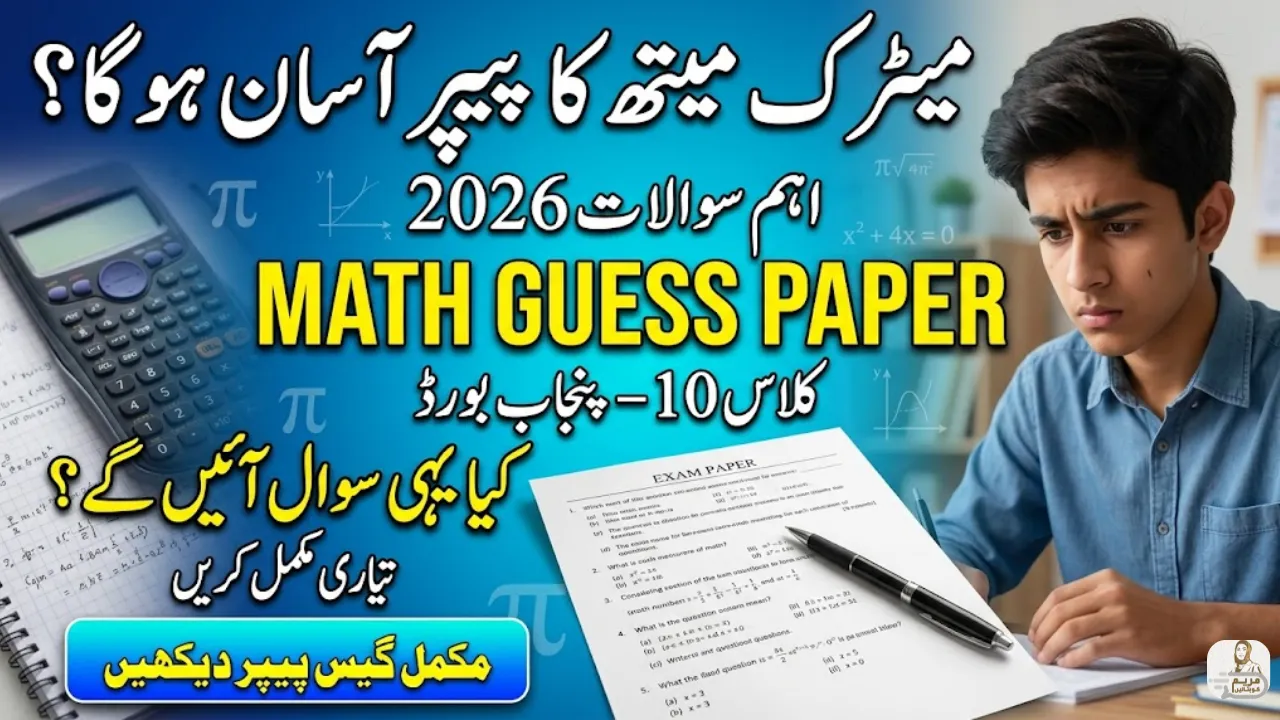
As the 2026 board exams get closer, many students start searching for the most effective way to prepare mathematics without wasting time. The reality is simple: success in math depends on smart focus, consistent practice, and understanding patterns. A well-prepared guess paper can help you move in the right direction.
This guide is designed to give you a clear, easy, and practical roadmap to score better without relying on risky shortcuts.
What Makes a Guess Paper Useful for Board Exams?
A guess paper is not magic—it’s a smart summary of important areas based on previous exam trends. It highlights:
- Frequently repeated questions
- Important exercises from each chapter
- Key concepts that examiners focus on
Instead of studying everything blindly, students can prioritize topics that carry higher weight.
High-Weight Chapters You Should Not Ignore
Based on Punjab Board paper patterns, the following units deserve extra attention:

| Priority Level | Topics |
|---|---|
| High | Algebra (Quadratic Equations, Factorization) |
| High | Trigonometry Basics & Identities |
| Medium | Matrices & Determinants |
| Medium | Geometry (Theorems, Circles) |
| Important | Functions & Graphs |
👉 Tip: If time is short, focus more on algebra and trigonometry—they usually carry strong marks distribution.
Download Now Guess Papers – 10th-Math-Guess-Paper-2026
Most Expected Question Types in 2026 Exams
Instead of memorizing everything, prepare these patterns:
- MCQs from formulas and identities
- Short questions from definitions and rules
- Theorems (especially from geometry units)
- Long questions from algebraic solving
- Practical problems involving trigonometry
Students who practice these formats regularly feel more confident in the exam hall.

Smart Preparation Strategy (Proven Method)
A balanced approach always works better than random study.
Step 1: Start with Basics
Clear your concepts first. Weak basics create confusion later.
Step 2: Practice Important Questions
Solve selected exercises instead of the entire book blindly.
Step 3: Revise Formulas Daily
Math becomes easy when formulas are strong.

Step 4: Use Guess Paper for Final Revision
This helps you quickly cover important areas before exams.
Common Mistakes That Reduce Marks
Avoid these if you want better results:
- Studying without solving questions
- Ignoring weak topics completely
- Relying only on predicted questions
- Poor time management during exam
Even a strong student can lose marks due to these simple mistakes.
Last 10 Days Study Plan
If exams are very near, follow this:

- Daily: 2–3 hours problem solving
- Revision: 1 hour formulas + concepts
- Practice: Focus on repeated questions
Consistency matters more than long study hours.
FAQs
Is it safe to prepare only selected questions?
No, always understand concepts along with practice.
Can I pass with limited preparation?
Yes, if you focus on key topics and practice regularly.
Are guess questions always repeated?
Not exactly, but similar patterns often appear.

Which section is easiest to score?
MCQs and short questions if concepts are clear.
Final Thoughts
Preparing for math doesn’t require studying everything—it requires studying the right things in the right way. A smart combination of concept clarity, focused practice, and strategic revision can significantly improve your performance.
Stay consistent, avoid shortcuts, and trust your preparation. With the right approach, mathematics can become one of your highest scoring subjects in the Punjab Board exams.